The Southern colonies developed a distinctive culture shaped by plantation agriculture, enslaved labor, warm climate, and a hierarchical social structure that still echoes through Southern home design today. From the grand symmetry of Georgian manor houses to the wide porches built for shade and hospitality, these early settlers created architectural and decorative traditions that prioritized natural cooling, outdoor living spaces, and materials suited to humidity and heat.
Understanding this cultural foundation helps explain why Southern interiors in 2026 still favor high ceilings, cross-ventilation, natural fibers like cotton and linen, and a blend of formal entertaining spaces with casual, lived-in comfort. The plantation economy brought wealth to a small elite class who imported European furnishings and craftsmen, establishing preferences for mahogany, chinoiserie, and classical proportions that became hallmarks of Southern taste. Meanwhile, the agricultural rhythm of life, dependence on waterways for commerce, and hot summers created practical design solutions that modern homeowners continue to embrace.
The colonies’ social customs, from formal dining rituals to afternoon visiting traditions, influenced room layouts and furniture choices that persist in contemporary Southern homes. Climate adaptations weren’t merely functional but became aesthetic signatures: shuttered windows, columned verandas, and breezeway construction evolved into beloved design elements. This historical context reveals why certain materials, colors, and spatial arrangements feel inherently Southern, offering homeowners a roadmap to authentically honor regional heritage while creating comfortable, beautiful spaces for today’s lifestyle.
The Five Southern Colonies and Their Cultural Foundations
The five Southern colonies, Maryland, Virginia, North Carolina, South Carolina, and Georgia, developed remarkably different personalities despite sharing a regional identity. Virginia, established in 1607, became the wealthiest and most influential, building its fortune on tobacco cultivation and creating an aristocratic planter class that valued formal architecture and imported English goods. Maryland, founded as a haven for Catholics in 1632, developed a more religiously tolerant culture while still embracing the plantation economy that shaped its grand estates and material culture.
The Carolinas took divergent paths after their 1663 founding. North Carolina’s geography favored small farms and a more egalitarian society, while South Carolina’s Lowcountry became synonymous with rice and indigo wealth, creating Charleston’s legendary culture of refinement and craftsmanship. Georgia, the youngest colony (1733), started as a philanthropic experiment but quickly adopted the plantation model, blending humanitarian ideals with the economic realities that defined the region.
What unified these diverse colonies was an economy built on cash crops and the leisure class it created. Plantation culture wasn’t just an economic system, it shaped how Southerners thought about home. Dispersed settlement patterns made hospitality essential rather than optional. When neighbors lived miles apart, welcoming guests meant providing overnight accommodations, formal dining spaces, and comfortable gathering areas. This necessity evolved into the gracious living ideal that remains central to Southern identity.
Coastal trade brought material wealth and access to English and European goods, creating a culture that valued fine furnishings, quality textiles, and architectural sophistication. Yet the Southern colonies also developed their own regional craftsmanship traditions, blending imported styles with local materials and climate-responsive adaptations. This balance between cosmopolitan aspiration and practical adaptation to Southern conditions created a distinctive aesthetic that homeowners still seek in 2026.
Architectural Legacy: From Colonial Homes to Modern Southern Design
Climate-Driven Design Elements
The sweltering heat and oppressive humidity of the Southern colonies forced settlers to become ingenious architects out of necessity. They couldn’t simply replicate the compact, heat-trapping homes of England, survival demanded adaptation. High ceilings became standard because hot air rises, creating a buffer zone above residents’ heads and making rooms feel cooler even without modern air conditioning. This principle of vernacular ventilation design shaped every aspect of colonial Southern architecture.
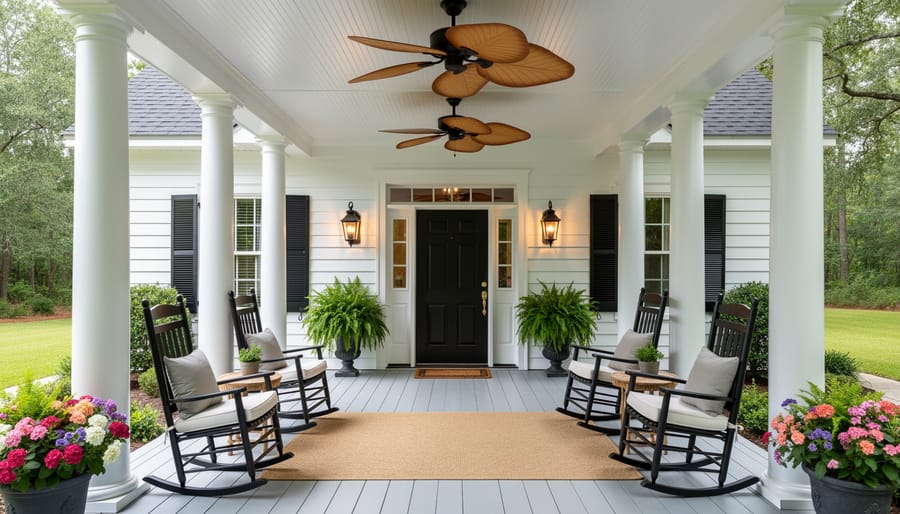
Wide covered porches served triple duty: they shaded walls and windows from direct sun, created outdoor living spaces during the hottest months, and protected the home’s exterior from driving rain. Colonists experimented with porch ceiling materials that would reflect light and deter insects while standing up to moisture. Strategic window placement enabled cross-ventilation, allowing breezes to flow through the house and push out stale, hot air. Operable shutters weren’t decorative, they regulated light and heat while providing storm protection and security.
These climate-responsive features remain popular in 2026 Southern homes not just for their historical charm, but because they still work. Even with central air conditioning, high ceilings reduce cooling costs, porches extend living space, and cross-ventilation offers relief during spring and fall. Colonial necessity created lasting beauty.
The Georgian and Colonial Revival Influence
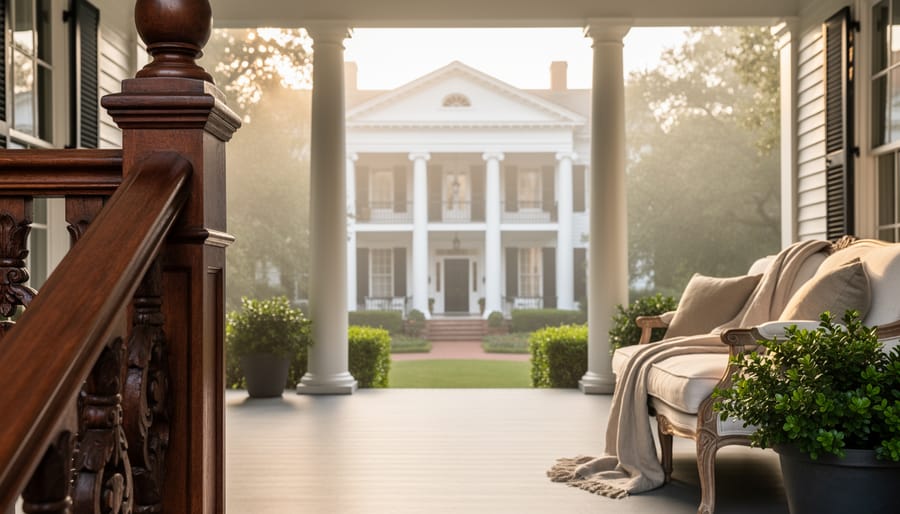
Georgian architecture arrived in the Southern colonies during the 18th century as a statement of prosperity and refinement. Wealthy plantation owners embraced its balanced proportions, centered doorways flanked by equal windows, and strictly symmetrical facades. These formal design principles communicated status and cultivation, values that still resonate in Southern home design today.
The Georgian emphasis on order extended indoors through carefully proportioned rooms arranged around a central hallway. This axial layout wasn’t merely decorative. It created natural cross-ventilation while organizing social spaces with clear hierarchy: public rooms flanking the entry, private chambers above, service areas behind.
When the Colonial Revival movement swept America in the early 20th century, the South embraced it enthusiastically. Homeowners recognized these classical details as authentically their own heritage. Dentil molding, pediments over doors, multi-pane sash windows, and paneled wainscoting became signatures of quality construction.
In 2026, these elements remain foundational to Southern interiors. You’ll find them in new builds that faithfully recreate Georgian proportions and in historic renovations that preserve original millwork. Even contemporary Southern homes often incorporate simplified versions, clean symmetry, classical door surrounds, traditional crown molding, as anchors that balance modern materials and casual coastal furnishings. The formality has softened, but the bones remain Georgian.
Material Culture: Textiles, Furnishings, and Craftsmanship
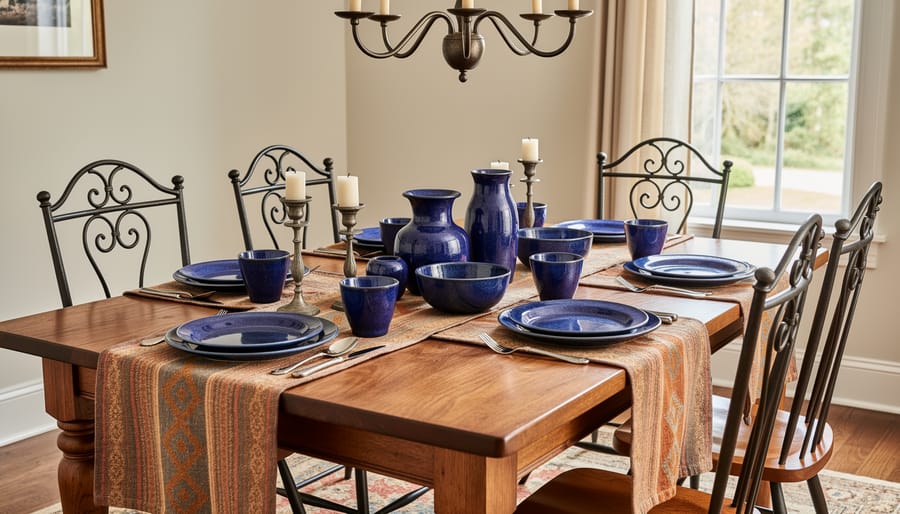
The material culture of the Southern colonies reflected both the wealth generated by plantation agriculture and the practical realities of colonial life far from English supply lines. Wealthy planters imported fine mahogany furniture, damask draperies, and English ceramics to demonstrate their status and maintain ties to British culture. Yet distance and necessity also fostered local craftsmanship that produced distinctly Southern forms: cypress wardrobes built to withstand humidity, heart pine flooring that could endure generations of wear, and handcrafted tables designed for the expansive entertaining that Southern hospitality demanded.
Colonial artisans working in wood, iron, and textile quickly adapted European techniques to regional materials and climate. This produced furniture with looser joinery that accommodated wood movement in humid summers, textiles woven from locally grown fibers, and decorative ironwork forged to last in coastal salt air. The result was a material aesthetic that valued durability, honest construction, and regional adaptation over pure fashion, principles that continue to guide Southern décor choices in 2026.
Several colonial-era materials and techniques remain cornerstones of authentic Southern interiors:
- Cypress and heart pine wood for flooring, paneling, and cabinetry, prized for natural moisture resistance
- Hand-woven textiles in linen and cotton, often featuring indigo dyes or natural fibers
- Wrought iron details for hardware, railings, and light fixtures
- Brick and tabby construction for fireplaces, foundations, and accent walls
- Indigo-dyed fabrics reflecting South Carolina’s historical role in the indigo trade
Modern Southern homes honor this heritage by choosing quality over quantity and natural materials over synthetic alternatives. Built-in furniture echoes the colonial practice of commissioning custom pieces suited to specific rooms and needs, while built-in fireplace shelving continues the tradition of integrated cabinetry that maximized storage in colonial homes. Contemporary coastal interiors frequently incorporate reclaimed heart pine, vintage textiles, and handcrafted ironwork, not as museum pieces, but as functional elements that connect today’s homes to centuries of Southern craftsmanship.
Southern Hospitality: The Cultural Heart of Home Design
Southern hospitality isn’t just a charming phrase, it’s a design philosophy with deep colonial roots. In the scattered settlements of the Southern colonies, where neighbors might live miles apart and formal inns were scarce, opening your home to travelers and guests wasn’t merely polite. It was a social obligation and a mark of status. Plantation owners and merchants built their homes to accommodate this expectation, creating architectural features specifically designed for welcoming and hosting others.
The formal dining room emerged as the social heart of colonial Southern homes, often the largest and most elaborately finished room in the house. These weren’t casual breakfast nooks. They were designed for extended meals, business negotiations, and displays of prosperity. This tradition explains why even modest Southern homes today often prioritize a proper dining room over a larger kitchen, preserving space where family and guests can gather around a table.
Entryways in colonial Southern homes made immediate statements about welcome and status. Wide central halls with doors at both ends created cross-ventilation while serving as reception spaces where visitors could be greeted and sorted, formal guests shown to parlors, business associates to offices, family directed to private quarters. Today’s grand Southern foyers with impressive staircases trace directly to this colonial need to receive guests with grace.
Guest accommodations weren’t afterthoughts. Many colonial homes included dedicated guest chambers, sometimes entire wings, because visitors often stayed for days or weeks given the distances involved. The modern Southern tradition of maintaining a well-appointed guest room, even in smaller homes, honors this heritage.
Covered porches and piazzas served as outdoor living rooms where hospitality extended beyond interior walls, offering shaded spaces for conversation, meals, and socializing during hot months. These transitional spaces remain essential to Southern home design, embodying the cultural imperative to create comfortable, welcoming environments that draw people together.
Color Palettes Rooted in Colonial Life
The colors that define Southern interiors today aren’t arbitrary choices, they’re direct descendants of the colonial economy, climate, and available materials. From the indigo plantations of South Carolina to the clay-rich soil of Virginia, the Southern colonies developed a distinctive palette born from what they grew, traded, and built with.
Indigo blue dominates Lowcountry homes because indigo was South Carolina’s most valuable cash crop throughout the 18th century. Planters like Eliza Lucas Pinckney made fortunes exporting the deep blue dye to England, and the color became synonymous with coastal wealth and refinement. Rice field greens emerged from the same agricultural landscape, where vast paddies of emerald rice stretched across the tidal marshes. These weren’t decorative choices, they were daily visual references that colonists lived with and eventually brought indoors.
The warm whites and soft creams ubiquitous in Southern homes trace back to practical necessity. Whitewash protected wood from humidity and insects while reflecting heat in those pre-air-conditioning summers. Colonists mixed lime, water, and sometimes milk to create breathable coatings that kept homes cooler and brighter. Brick red came naturally from the Georgia and Carolina clay used to make the bricks themselves, a warm terracotta that appeared in foundations, chimneys, and entire facades.
| Color | Colonial Source | Modern Application |
|---|---|---|
| Indigo Blue | Indigo crop trade, plantation wealth | Accent walls, upholstery, cabinetry |
| Rice Field Green | Lowcountry rice paddies | Kitchen islands, exterior shutters, textiles |
| Warm White | Lime whitewash for heat reflection | Primary wall color, trim, ceiling beams |
| Brick Red/Terracotta | Local clay deposits | Flooring, accent pieces, exterior details |
| Tobacco Brown | Dried tobacco leaves, barrel aging | Wood stains, leather furnishings |
These historically rooted colors work in 2026 Southern homes precisely because they evolved from regional conditions that haven’t changed. The humidity, the light quality, the connection to agriculture and coast, these remain constant. When you paint a room in Lowcountry indigo or choose warm white shiplap, you’re not mimicking colonial style. You’re continuing a practical color tradition that has proven itself functional and beautiful for three centuries.
Gardens and Outdoor Spaces as Cultural Expressions
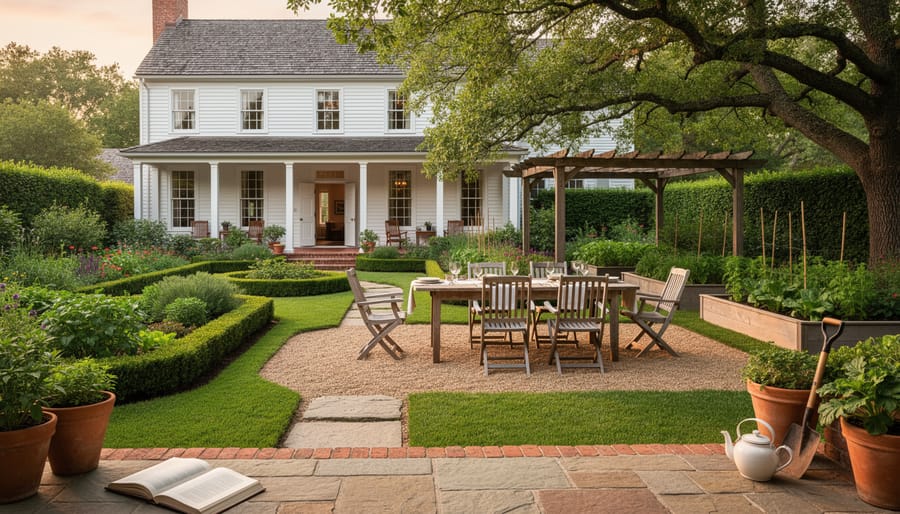
In the Southern colonies, a well-tended garden wasn’t just decoration, it was a statement of prosperity, cultivation, and mastery over the land. Wealthy planters created formal gardens modeled on English estates, with symmetrical boxwood hedges, geometric planting beds, and central focal points like fountains or statuary. These ornamental gardens demonstrated refinement and social standing while providing pleasant views from the main house.
Equally important were the kitchen gardens, typically located closer to the work areas of the property. These practical spaces grew herbs, vegetables, and medicinal plants essential for daily life. The blend of beauty and utility reflected a colonial worldview where aesthetics and function existed together without conflict.
This dual approach to landscape design remains deeply embedded in Southern outdoor living. Modern Southern homes still favor layered landscapes that combine formal plantings near the house with more relaxed, productive areas beyond. The colonial love of porches and covered outdoor rooms, originally designed for escaping heat while enjoying garden views, translates directly into today’s generous outdoor entertaining spaces.
The Southern practice of treating the yard as outdoor rooms, each with distinct purposes, traces back to these colonial origins. Front gardens welcome guests with formality, side gardens might feature cutting flowers or herbs, and rear yards become private retreats. Even in smaller modern lots, this zoned approach to landscape design honors the colonial understanding that outdoor spaces extend and enhance the home itself, not merely surround it.
Bringing Colonial Culture into Your Home Today
You don’t need period antiques or formal reproductions to honor colonial traditions in your home. Start with the underlying principles: choose quality over quantity, prioritize natural materials, and design spaces that welcome people. A solid wood dining table, linen curtains that catch the breeze, or wide-plank flooring in warm tones all echo colonial values without looking like a historical reenactment. Focus on craftsmanship and durability rather than chasing a specific era’s aesthetic.
The climate-responsive features that made colonial homes livable still work beautifully today. Install operable shutters, not just decorative ones. Design your porch as a true living space with comfortable seating and ceiling fans. Use high-contrast trim to define architectural details, and paint walls in historically-rooted colors like soft ivory, deep indigo, or warm gray-green. These choices connect to colonial precedent while fitting seamlessly into contemporary life.
How can I add colonial character without formal antiques?
Focus on design principles rather than period pieces: use natural materials like wood and linen, create welcoming gathering spaces, and choose quality craftsmanship. Simple wide-plank floors, painted wood furniture, and functional shutters capture the spirit without requiring authentic antiques.
What’s the difference between colonial and plantation style?
Colonial refers to the broader cultural period and design principles of 1600s-1700s settlements, while plantation style specifically evokes the grand estates of wealthy landowners. You can embrace colonial design values without the problematic associations of plantation imagery.
How do coastal and colonial Southern styles work together?
They’re natural partners. Both prioritize airflow, natural light, organic materials, and indoor-outdoor living. Coastal elements like sisal rugs and whitewashed wood complement colonial features like symmetrical layouts and traditional proportions.
Can modern homes embrace colonial culture authentically?
Absolutely. The cultural values, hospitality, climate adaptation, quality materials, connection to place, translate perfectly to contemporary design. Thoughtful integration respects history while serving how you actually live.
Layer in vintage Southern decor pieces that tell a story rather than filling rooms with reproductions. A single heirloom piece or salvaged architectural element carries more weight than a roomful of new items styled to look old. This approach to cultural storytelling keeps your home grounded in tradition while remaining distinctly yours. Balance historical nods with modern comfort, colonial culture valued gracious living, and there’s nothing gracious about sacrificing function for appearance.
Understanding the culture of the Southern colonies gives your home design authentic depth that goes beyond surface aesthetics. When you choose wide porches, airy layouts, and welcoming entryways, you’re not just following trends, you’re connecting with principles developed over centuries to create comfortable, livable spaces suited to Southern life.
The colonial emphasis on hospitality, quality craftsmanship, and climate-responsive design remains remarkably relevant in 2026. These aren’t museum pieces to replicate exactly, but foundational ideas that solve real problems: how to stay comfortable in heat and humidity, how to create spaces that welcome family and friends, how to build homes that feel rooted in place rather than generic.
Whether your style leans traditional or contemporary coastal, these cultural roots offer guidance. High ceilings and cross-ventilation still work better than fighting the climate. Thoughtfully chosen materials and furnishings still outlast disposable décor. Spaces designed for gathering still create the warmth that makes a house feel like home.
The Southern colonies gave us more than historical architecture. They established an approach to living, gracious, practical, and deeply connected to place, that continues to make Southern homes distinctive, comfortable, and genuinely welcoming.